China’s erosion control products industry has become increasingly important as infrastructure, mining, river restoration, and ecological construction expand. The United Nations Convention to Combat Desertification estimates that up to 40% of the world’s land is degraded, affecting billions of people. Its Global Land Outlook 2 also identifies soil loss, water stress, and land-use pressure as connected risks. These findings make erosion control more than a construction requirement. It is a long-term environmental investment.
China’s Ministry of Water Resources regularly monitors soil erosion across the country. Recent monitoring reports show that China’s soil erosion area has continued to decline, while ecological restoration projects remain active across grasslands, slopes, watersheds, and coastal zones. Manufacturers now supply geotextiles, erosion control blankets, geocells, drainage products, silt fences, and hydraulic growth media. Product quality can vary significantly. So can installation results.
This guide examines China’s top 10 erosion control products manufacturers through practical and measurable criteria. These include material performance, production capacity, testing systems, project experience, export capability, certifications, and after-sales support. Evidence from company records, technical documentation, and recognized environmental standards should guide the comparison. No ranking is perfect. Regional climate, soil texture, slope angle, and installation quality can change field performance dramatically. A blanket that works on a moist northern slope may fail under intense rainfall in southern China. That limitation matters.
The goal is not to promote the largest factory automatically. It is to identify manufacturers offering dependable solutions for real erosion risks. Readers should still verify test data, warranty terms, and project references before purchasing.
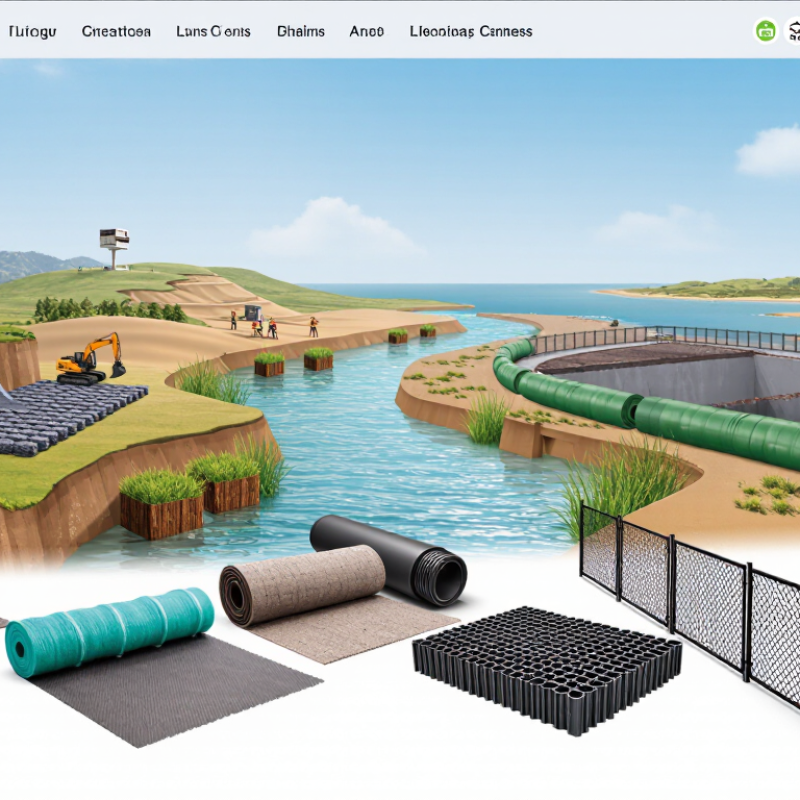
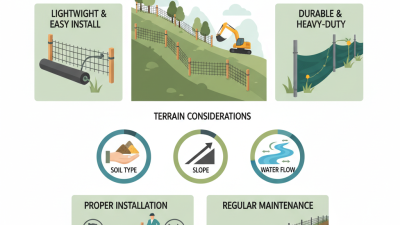
Erosion control products are materials and systems that reduce soil loss caused by rain, wind, runoff, or flowing water. They protect exposed ground while vegetation becomes established. Common options include straw or coconut-fiber blankets, turf reinforcement mats, geotextiles, silt fences, drainage channels, and rock-filled baskets. Each product serves a different risk, not merely a different appearance. Good selection begins with slope angle, soil type, rainfall intensity, and expected water velocity.
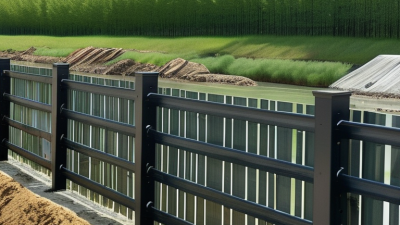
On a construction slope, an erosion control blanket can hold loose soil and seed in place. Along a site boundary, a properly trenched silt fence can slow sediment movement. In a drainage swale, check structures or stone protection may be more suitable.
Installation matters as much as material strength. Loose pins, poor overlaps, blocked outlets, or undersized anchoring can turn a well-rated product into a weak barrier. Manufacturer data, local regulations, and project drawings should be checked before purchase and placement.
There is no universal best erosion control product. A cheap blanket may fail on a steep, fast-draining slope, while a heavy system may disturb soil unnecessarily. Field monitoring should follow storms, not just installation. Look for undercut edges, rills, exposed roots, and sediment deposits. These details reveal whether water is bypassing the treatment. Vegetation is not instant protection. Until roots develop, temporary controls remain essential. Some sites also need redesign, because products cannot correct poor grading or concentrated runoff.
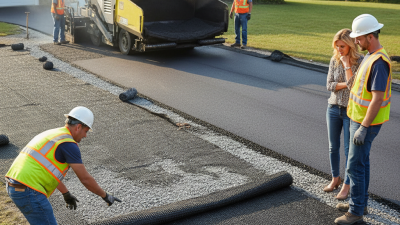
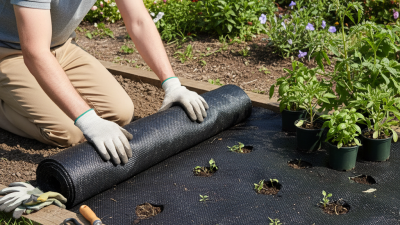
China’s erosion control industry produces several practical product types for slopes, riverbanks, roads, and construction sites. Geotextiles form the basic layer. Woven fabrics improve soil separation and reinforcement, while nonwoven fabrics support filtration and drainage. Coir and straw blankets cover exposed ground, retain moisture, and encourage vegetation growth. They work well on moderate slopes, but steep sites may require stronger structural support.
Hydroseeding mats combine seed, fiber, and biodegradable binders. They can reduce surface runoff before plants establish roots. Turf reinforcement mats add a three-dimensional structure for channels with heavier water flow. Rock-filled gabions and erosion control tubes provide heavier protection near waterways. Silt fences, sediment bags, and drainage channels help manage muddy runoff during construction.
China’s Ministry of Water Resources reported about 2.65 million square kilometers of soil erosion area in its 2023 water resources bulletin, showing the scale of demand for varied solutions.
Product selection should follow slope angle, rainfall intensity, soil texture, and expected flow velocity. The United Nations’ Global Land Outlook 2 states that up to 40% of the world’s land is degraded, with erosion as a major pressure. That figure demands caution. A blanket may appear effective, yet poor anchoring can cause failure after one storm.
Field testing, clear installation guidance, and verified material strength matter more than attractive specifications. Export buyers should also review tensile strength, permeability, biodegradation timing, and relevant test methods before comparing Chinese manufacturers.
A credible manufacturer begins with measurable performance, not attractive brochures. The FAO’s Status of the World’s Soil Resources report estimates that 25–40 billion tonnes of soil are lost globally each year. This figure makes product selection a technical decision, not a purchasing shortcut. Ask for independent test results covering rainfall intensity, slope angle, soil type, tensile strength, and vegetation establishment. Results should reference recognized methods, such as ASTM D6459 for rolled erosion control products and ASTM D6460 for turf reinforcement mats.
Factory quality also matters. Review batch records, raw-material controls, storage conditions, and corrective-action procedures. Request samples from different production dates. Compare their weight, fiber distribution, stitching, and biodegradable components under close inspection. A reliable manufacturer should explain installation limits clearly. It should also provide drawings, anchoring patterns, maintenance guidance, and field training. Vague instructions are a warning sign.
Look beyond laboratory results. The U.S. Federal Highway Administration emphasizes site-specific erosion and sediment control in its technical guidance. Therefore, evaluate whether the manufacturer has documented projects with similar rainfall, gradients, and soil conditions. Check warranty language carefully. It should define coverage, exclusions, and inspection duties. No supplier score is perfect. A checklist can still miss poor installation or unusual storm events. That weakness deserves discussion during technical review, not concealment. Ask for post-project monitoring data, including exposed soil, vegetation coverage, repair frequency, and performance after major rainfall.
China’s top 10 erosion control products manufacturers are increasingly judged by tested performance, not catalogue size. Their product range commonly includes coir and straw blankets, polypropylene erosion mats, geocells, turf reinforcement mats, silt fences, and drainage composites. Grand View Research reports that the global geosynthetics market was valued at more than USD 13 billion in 2023, with infrastructure and environmental protection driving demand. This trend is visible on Chinese project sites, where rolls are selected according to rainfall, slope angle, soil type, and vegetation targets.
Reliable manufacturers provide tensile strength, mass per unit area, permeability, UV resistance, and biodegradation data. They should also support testing under recognized ASTM, ISO, or equivalent Chinese standards. A 2024 industry assessment by MarketsandMarkets identified Asia-Pacific as the fastest-growing region for geosynthetics, supported by transport construction, water management, and land restoration. That growth creates opportunity, but quality can vary between similar-looking products. Some suppliers still emphasize low price over installation life. A costly weakness.
Practical evaluation should include factory traceability, batch records, third-party test reports, and project evidence from steep embankments or riverbanks. The strongest manufacturers explain anchoring patterns, overlap distances, and seedbed preparation. They also adapt specifications instead of forcing one standard product everywhere. In field experience, poor surface preparation can undermine even a high-strength mat. This point is often overlooked. Procurement teams should compare five-year performance, not only the quoted price.
| No. | Product Category | Typical Materials | Typical Commercial Specifications | Main Erosion-Control Function | Common Applications | Relevant Test Methods or Standards |
|---|---|---|---|---|---|---|
| 1 | Woven Geotextile | Polypropylene or polyethylene tape yarns | Typical mass: 80–300 g/m²; high tensile strength; roll widths commonly up to several metres | Separates soil layers, limits surface scour and improves subgrade stability | Roads, embankments, drainage layers and channel protection | ASTM D4595, ASTM D4595-related tensile testing, EN ISO 10319 |
| 2 | Nonwoven Geotextile | Needle-punched polypropylene or polyester fibres | Typical mass: 100–800 g/m²; filtration and drainage grades available | Filters soil particles, permits water flow and reduces piping and sediment migration | Slopes, retaining structures, drains, landfills and coastal works | ASTM D4491, ASTM D4751, ASTM D4632, EN ISO 12956 |
| 3 | Coir Erosion Control Blanket | Coconut fibres, netting and biodegradable stitching | Typical mass: 300–900 g/m²; service life commonly about 2–5 years depending on grade and climate | Provides temporary soil cover while vegetation becomes established | Steep slopes, riverbanks, wetlands and restoration projects | ASTM D6525, ASTM D6475, ASTM D5035 |
| 4 | Straw or Wood-Fibre Erosion Blanket | Straw, wood fibre, biodegradable netting or synthetic reinforcement | Typical mass: 200–600 g/m²; short- to medium-term degradation period | Reduces rainfall impact, runoff velocity and seed displacement | Vegetated slopes, roadside soil, construction sites and landscaping | ASTM D6475, ASTM D6525 and manufacturer-declared degradation testing |
| 5 | Turf Reinforcement Mat | Three-dimensional polypropylene or polyethylene geosynthetic structure | Typical thickness: 10–25 mm; open structure for root and soil interlock | Reinforces vegetation and improves resistance to concentrated flow | Drainage channels, swales, ditches and moderate-flow waterways | ASTM D6525, ASTM D6567 and hydraulic performance testing |
| 6 | Geocell Confinement System | High-density polyethylene sheets with welded or textured cell walls | Typical cell depths: 50–200 mm; cell sizes vary by slope and load design | Confines infill and reduces downslope movement, rutting and surface erosion | Steep slopes, unpaved roads, drainage channels and load-bearing surfaces | ASTM D5888, ASTM D6992 and project-specific shear or pull-apart testing |
| 7 | Hydroseeding Mulch | Wood fibre, cellulose fibre, recycled paper or blended organic fibres | Typical application rate: about 1,000–3,000 kg/ha, subject to slope and formulation | Retains moisture and protects seed and soil during germination | Large slopes, roadside revegetation, mine rehabilitation and parks | ASTM D2974 for organic content and project-specific erosion testing |
| 8 | Coir Fibre Logs and Wattles | Coir fibre packed in biodegradable netting | Typical diameters: 150–300 mm; supplied in standard roll lengths | Interrupts runoff, captures sediment and supports wetland vegetation | Contours, streambanks, shorelines, drainage channels and wetlands | ASTM D5338 for biodegradation assessment and site-specific hydraulic testing |
| 9 | Geosynthetic Clay Liner | Sodium bentonite clay between woven and nonwoven geotextiles | Typical bentonite mass: 3,500–6,000 g/m²; low hydraulic conductivity when properly hydrated | Limits seepage and prevents erosion caused by subsurface water movement | Ponds, canals, landfill caps, containment cells and water reservoirs | ASTM D5887, ASTM D5890 and ASTM D5993 |
| 10 | Gabion and Reno Mattress Systems | Galvanized steel or polymer-coated steel wire mesh filled with stone | Typical mesh wire diameters: approximately 2.2–4.0 mm; modular baskets and mattresses | Provides structural scour protection and dissipates flow energy | Riverbanks, bridge abutments, culverts, channels and retaining structures | EN 10223-3, ASTM A975 and project-specific stone and coating requirements |
Specifications are typical market ranges and may vary according to project design, soil conditions, hydraulic loading, climate and applicable procurement standards.
Applications should match site risk, not catalog categories. Geotextiles stabilize slopes, coir blankets protect freshly seeded soil, and drainage composites reduce water pressure behind retaining structures. On a construction site, a poorly anchored mat can lift after one storm. It looks minor. The repair is not.
The UNCCD’s Global Land Outlook 2 reports that up to 40% of global land is degraded, increasing demand for practical erosion controls. Buyers should compare tensile strength, permeability, ultraviolet resistance, and service life. ASTM D4632 supports grab tensile testing, while ASTM D4751 measures geotextile opening size. For drainage applications, EN 13252 is also relevant. Laboratory results matter, but installation experience matters too. Soil chemistry and slope angle can change performance.
Quality systems deserve equal attention. The ISO Survey 2022 recorded more than 1.2 million ISO 9001 certificates worldwide, showing its broad use as a quality-management benchmark. It does not guarantee every shipment. Export buyers should request batch test reports, product traceability, packing details, and inspection procedures. Moisture-sensitive rolls need sealed wrapping and protected loading. Customs documents must match the product’s correct HS classification, material, and intended use. Incoterms should define responsibility for damage and inland delivery. A lower price may hide weaker stitching, inconsistent coating, or incomplete testing. I would still verify field references, because paperwork can be perfect while performance remains uncertain.